The artistic research of Andreas Tscherrig unfolds through a highly expressive figurative style, in which the human face is progressively transformed into a sign, a structure and an emotional landscape. His works display remarkable visual coherence: enlarged eyes, red mouths, distorted profiles, intense fields of colour and black lines create an immediately recognisable visual vocabulary. The representation does not seek verisimilitude, but uses the figure as a starting point to explore inner states, tensions, and relationships between the individual and space. A central element throughout the entire series is undoubtedly the gaze. The eyes appear almost obsessively, either in isolation or embedded within faces subjected to fragmentation and distortion.
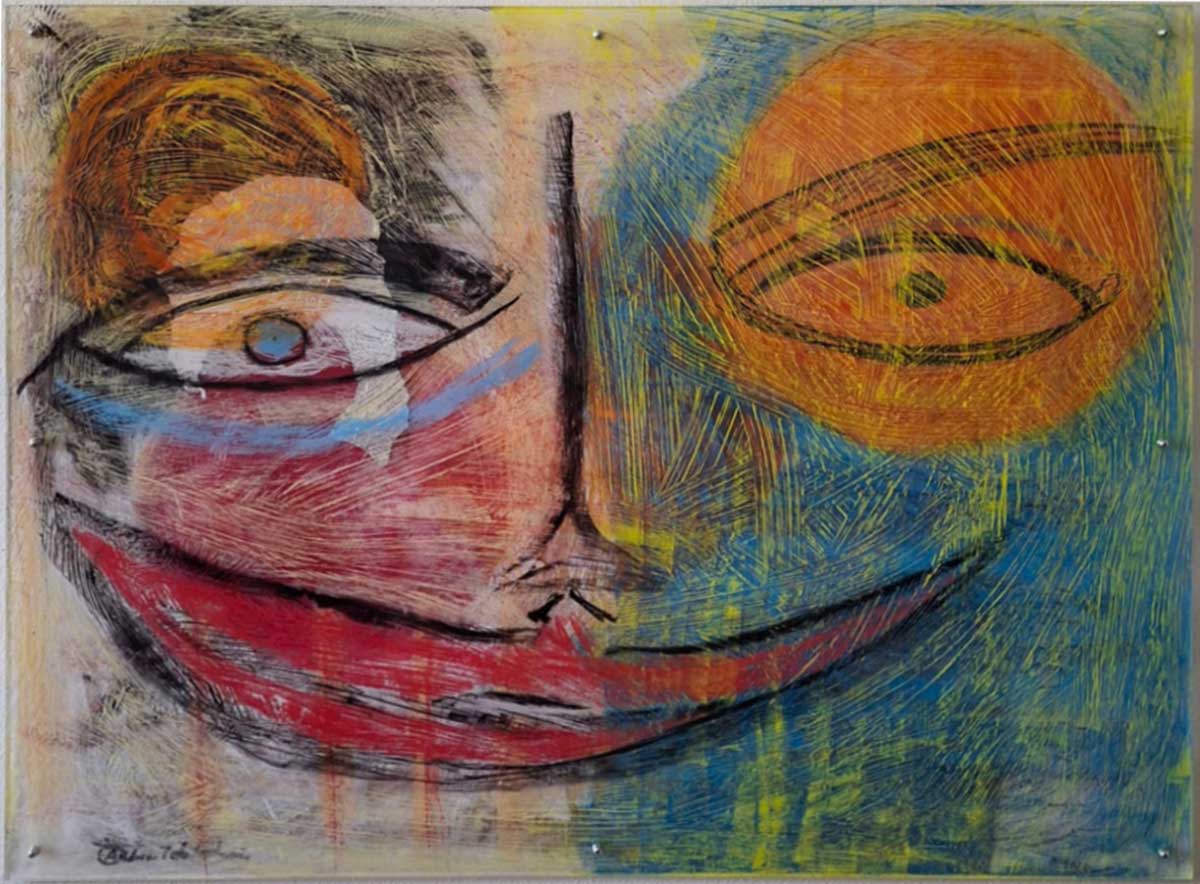
In Repair, they occupy a large part of the pictorial surface and seem to belong simultaneously to a figure and an abstract construction. The black line organises the face into large areas of colour, while the red of the mouth introduces an element of strong tension. The physiognomy thus becomes a mental rather than an anatomical structure: what interests the artist is not to depict an individual, but to make a perceptual condition visible.
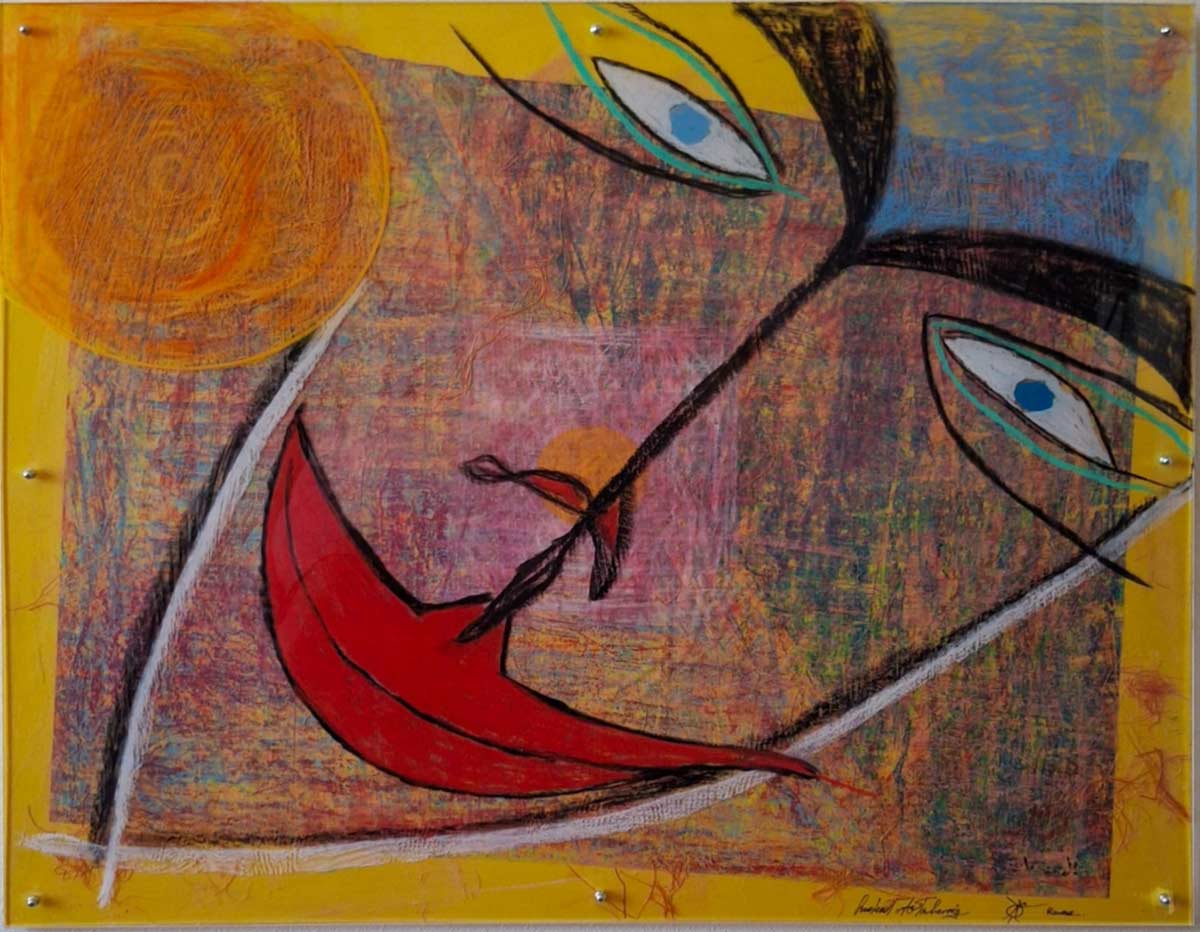
This approach is particularly evident in Zino, where the face almost entirely fills the field of vision. The blue eyes, the large central black mark and the red mouth establish just enough figurative references to preserve the recognisability of the human presence. Around them, a layered surface unfolds, crossed by marks, abrasions and overlapping colours. The interplay of yellow, pink, blue and black creates a tension that makes the face simultaneously ironic, unsettling and theatrical.
In Dreamers, the figurative component appears instead to be more fully absorbed into the material. Blue, orange, red and black overlap, creating a complex texture from which eyes and fragments of forms emerge. The subject seems to emerge from the painting while simultaneously dissolving into it. Particularly significant is the way Tscherrig allows controlled marks to coexist with more gestural interventions: the surface retains traces of the creative process and becomes an integral part of the image.
Both What a Dog’s Life…!! and Sun further confirm this interplay between construction and spontaneity.
In the former, the face is traversed by a multitude of vertical, horizontal and diagonal lines, set against a particularly vivid palette. In the latter, the large solar form dominates the upper part of the composition, while the face beneath takes on an almost mask-like appearance. The image possesses an intense frontal quality: the eyes establish a direct connection with the viewer, while the colour amplifies this presence.
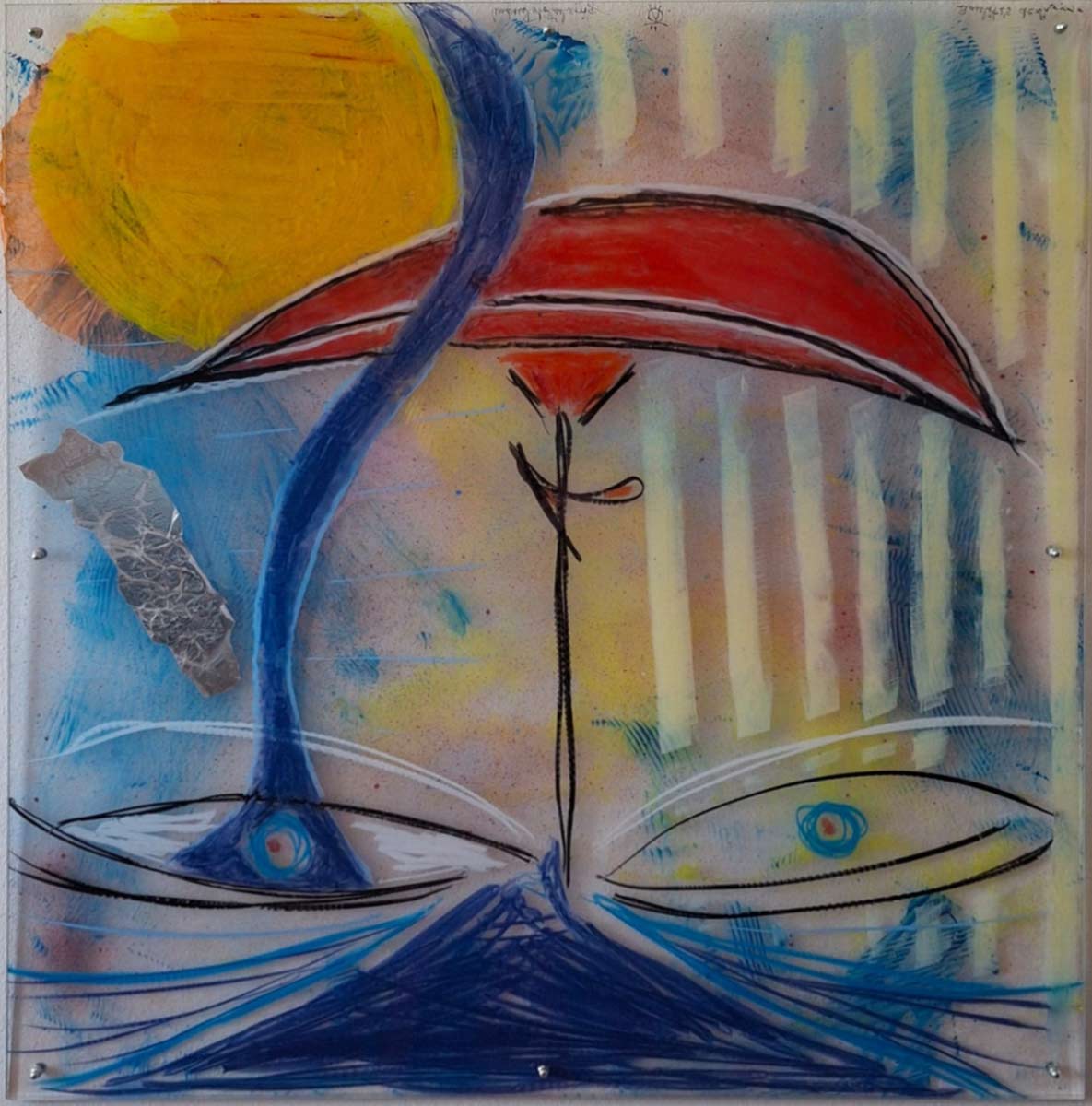
In other works, the face is further reduced to its essentials. Large red arcs, circular elements and blue lines construct physiognomies reduced to a few essential marks. The figure remains recognisable precisely through the repetition of certain elements: eye, mouth, nose, sun. This ability to preserve recognisability even through pronounced distortion is one of the most interesting aspects of the artist’s visual language.
Baselitz’s Death introduces an explicit reference in its title, while visually retaining the artist’s distinctive personal vocabulary. The large head, the orange disc, the violet and light blue colour fields, and the red mouth create a monumental, almost totemic presence. The face does not appear as a psychological portrait, but rather as a symbolic image subjected to a process of pictorial reconstruction.
From a technical perspective, the choice to work on transparent supports is also significant, allowing the wall behind to become a visual part of the composition. Transparencies, layering, scratches, painted passages and material inserts create surfaces in which the support is not neutral, but contributes to the perception of the work and its relationship with the surrounding space.
Overall, Andreas Tscherrig’s body of work reveals a distinctive artistic exploration based on the interplay between figuration, abstraction and gestural expressionism. The repetition of the face, and above all the gaze, does not lead to uniformity but serves as a framework through which to experiment with different balances of colour, material and mark-making. The result is an energetic and deliberately unstable visual universe in which human identity seems to be continually constructed, fragmented and reassembled on the surface of the artwork.